Most Shopify merchants build their warehouse operations backwards. They start selling, volume grows, problems appear — and each problem gets a patch. A spreadsheet here, a WhatsApp group there, a weekly recount to fix the numbers.
It works until it doesn't. And when it stops working, it stops working everywhere at once: the inventory is wrong, the picker can't find the product, the return pile has become furniture, and the one person who understands the system is on holiday.
This guide is the map of the whole territory. Six chapters, each covering one operational domain, each linking to the complete guide for that topic. Read it start to finish to design your operation — or jump to the chapter where it currently hurts.
Chapter 1 — Inventory accuracy: the foundation everything sits on
Every warehouse problem eventually traces back to one question: does the number in Shopify match what is physically on the shelf?
When it doesn't, the gap is called inventory drift — and it is the root cause behind overselling, phantom stockouts, failed picks, and the Monday-morning reconciliation ritual. Drift is not a Shopify bug. It accumulates from physical movements that happened without being recorded: a return restocked without inspection, a delivery received against the delivery note instead of the purchase order, a damaged unit set aside but never written off.
Three guides cover this domain completely:
How to Fix Inventory Drift in Shopify explains why drift happens and how to close the gap permanently — not with more frequent counts, but with real-time recording of every movement.
How to Stop Overselling on Shopify covers the most expensive symptom of drift: taking money for stock you don't have. Four causes, four direct fixes.
Shopify Inventory Not Syncing? Here's How to Fix It handles the technical layer — app conflicts, webhook failures, location mismatches, and API limits that break the connection between your systems.
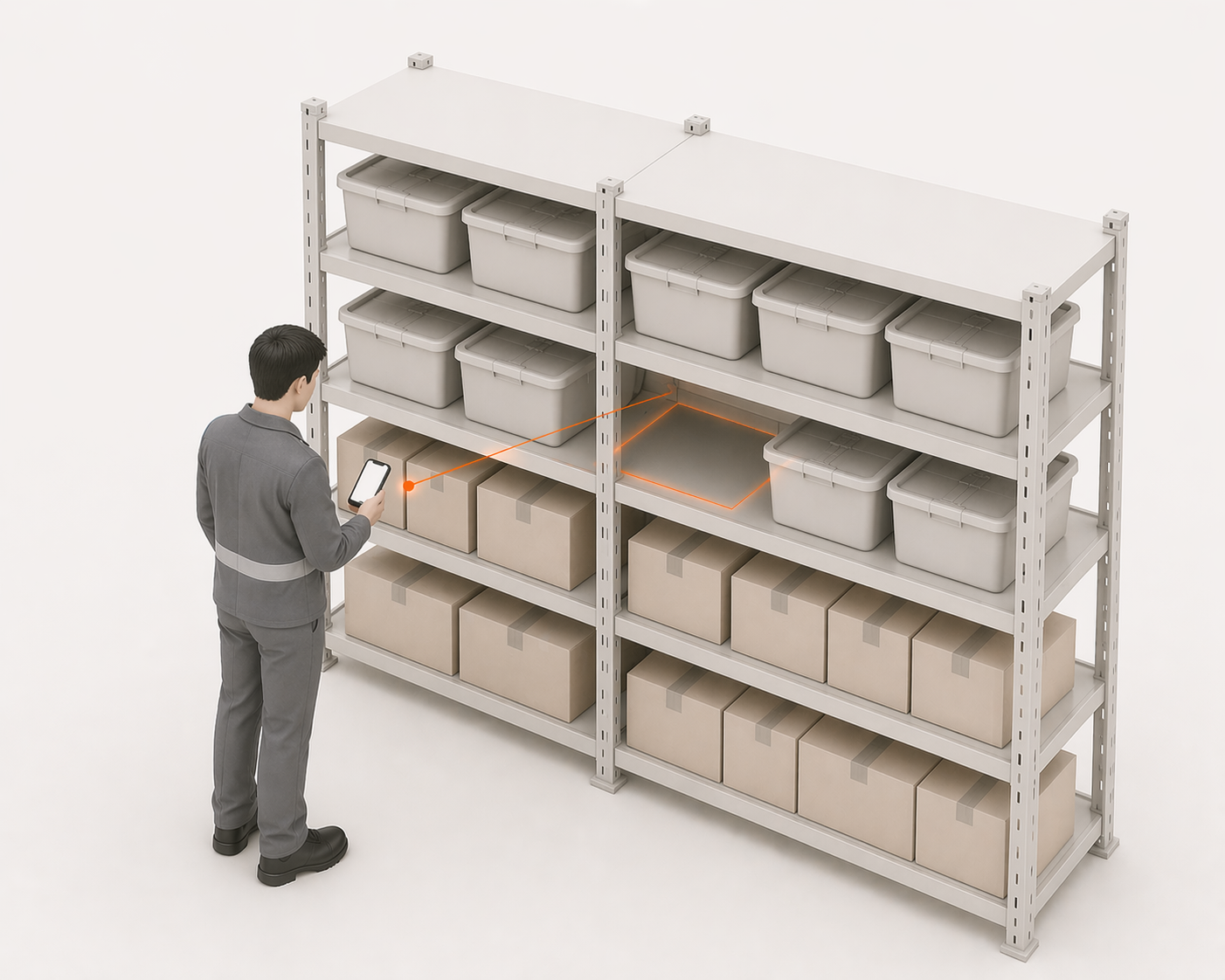
Chapter 2 — Warehouse setup: making stock findable
A warehouse where only one person knows where things are is not a warehouse — it is a memory with shelves.
01.Location structure
Every sellable unit needs a recorded home: zone, shelf, bin. A simple coordinate like A-03-B is enough if it is recorded every time stock moves. High-velocity SKUs go closest to packing; slow movers and overstock go furthest away. With locations recorded, a brand-new picker can find any product on day one without asking anyone.
02.Barcode standards
If it cannot be scanned, it cannot be verified. Every product needs a scannable barcode — the manufacturer's EAN or UPC where it exists, a printed label where it doesn't. The scan is what connects physical movement to system record.
03.Zones for exceptions
Returns need a separate zone from receiving — they require inspection before restocking. Damaged and uncertain stock needs a problem area — an explicit home for exceptions so nothing lives "somewhere" while Shopify counts it as sellable.
The full setup playbook — including the receiving process, pick and pack workflow, and daily operational rhythm — is in How to Run a Shopify Warehouse with a Small Team, the most comprehensive operational guide we have published.
Chapter 3 — The warehouse workflow: how stock moves
Stock follows a physical path: inbound dock, receive zone, stow zone, pick zone, pack stations, shipping dock. Each handoff is a place where accuracy is either preserved or lost.
The two highest-leverage steps are the ones most small warehouses skip. Receiving against the purchase order — not the delivery note — catches supplier discrepancies before phantom units enter your system. And inspecting returns before restocking prevents ghost inventory, where the count goes up but sellable stock does not.
The Shopify Warehouse Workflow guide walks the complete path from receiving to shipping, including the returns zone and problem center that keep exceptions from silently corrupting your stock accuracy.
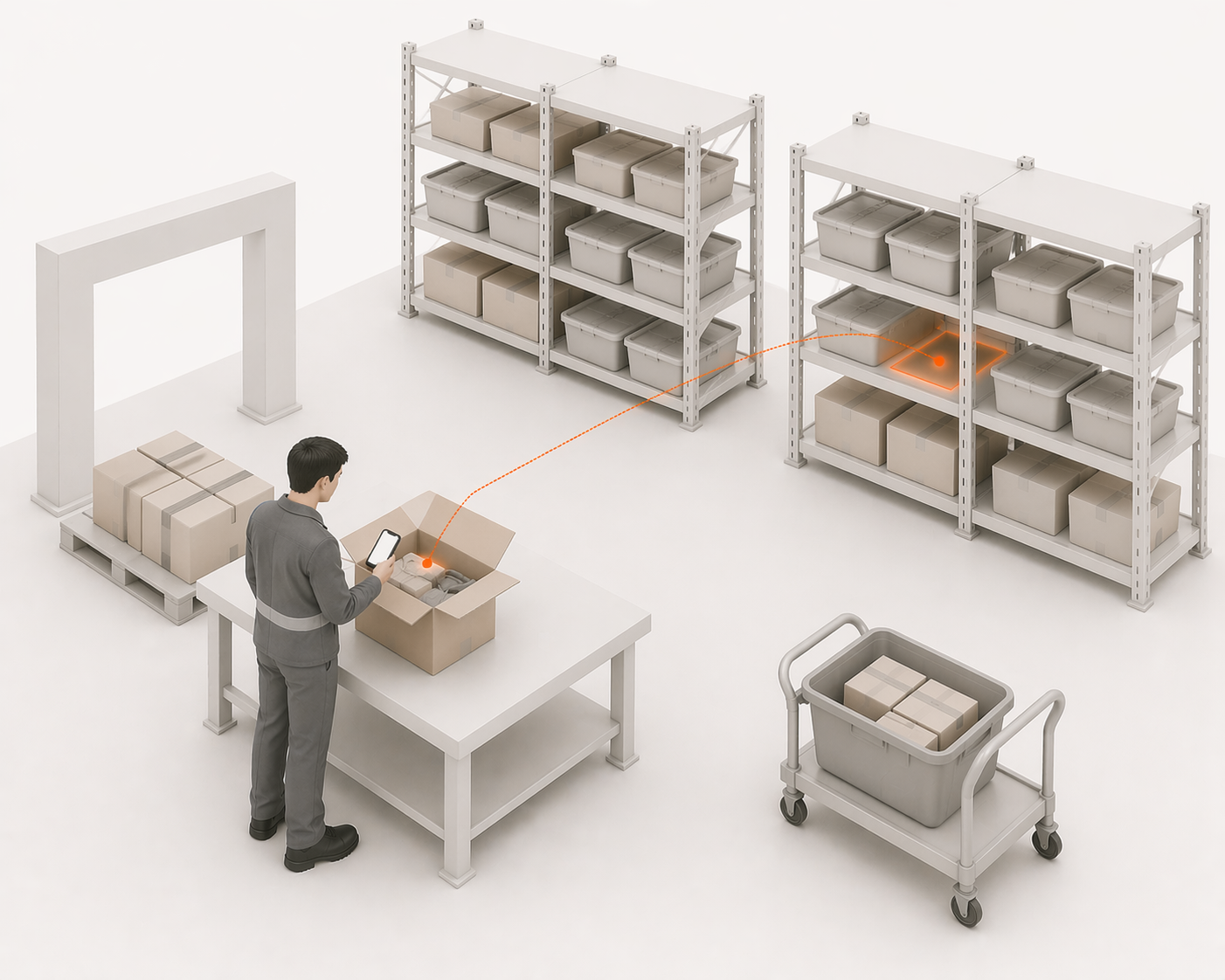
Chapter 4 — Order fulfillment: from order to parcel
The warehouse workflow moves stock. The fulfillment workflow moves orders — and the core principle is that the warehouse floor should only receive executable work.
Most fulfillment chaos comes from blocked orders reaching pickers: an order with missing stock, an address problem, a payment flag, or a packaging requirement that nobody resolved. A block check between Shopify and the floor holds these orders visibly until they are ready, while clear orders flow into a ready pool and get released in controlled batches.
The Shopify Order Fulfillment Workflow guide covers the complete path: block check, orders pool, batch release, pick, pack, and shipping before carrier cutoff.
Chapter 5 — Choosing your systems
Every process in this guide can be run manually at low volume. Above roughly 50 orders per day, the volume of movements and verifications exceeds what memory and spreadsheets can reliably track — and the system question becomes unavoidable.
The market splits into two camps that leave most small merchants stranded in the middle. Enterprise platforms — Cin7, Linnworks, Brightpearl — are genuinely powerful and genuinely mismatched to a 5-person warehouse: multi-week implementations, IT requirements, and pricing built for operations teams. Lightweight inventory apps handle stock adjustments but do not manage warehouse operations at all.
Start with Best WMS for Shopify Small Business for the honest comparison by operational fit. Then Does Shopify Have Built-In Warehouse Management? explains exactly where Shopify's native tools end, what a WMS adds, and how the integration actually works.
If you are evaluating a specific platform, the comparison guides cover the three most common: Cin7, Linnworks, and Brightpearl — what each is built for, what it costs, and what fits when it doesn't fit you.
Chapter 6 — Operations by industry
The fundamentals are universal. The failure modes are not.
Apparel breaks on variant complexity — every style multiplies into a size and colour matrix where a single stockout hides among dozens of variants: the apparel guide. Beauty and supplements add expiry dates and batch tracking that Shopify has no concept of: beauty and supplements. Auto parts demands fitment verification on every pick — the right part for the wrong vehicle is still a return: the auto parts guide. Sports and hobby retailers manage seasonal demand swings across deep catalogues: the sports and hobby guide.
For Nordic merchants, the operational guides are also available in Swedish and Danish.

Where to start
If you read one thing, read the chapter where it currently hurts. If everything hurts, start with Chapter 1 — inventory accuracy is the foundation, and every other process inherits its quality.
And if you are between Shopify's native tools and enterprise systems you don't need, that gap is exactly what we are building LaSyncro for: the operational layer for small Shopify warehouses, connected in 60 seconds, designed for the people doing the work.
LaSyncro is the operational layer for small Shopify warehouses — connected in 60 seconds.
Start free