
If you manage your own warehouse and run Shopify, you have almost certainly felt this gap. Your Shopify admin shows stock counts. It accepts orders. It decrements inventory when something sells. But it cannot tell you where in your warehouse that item actually lives, who should go and get it, whether the right item was picked, or whether the delivery that arrived this morning matched what was on the purchase order.
That gap — between inventory visibility and warehouse operations — is where most growing Shopify merchants lose time, make errors, and accumulate the drift that eventually causes stockouts and oversold orders.
This guide covers exactly what Shopify provides natively, what a warehouse management system actually does, the specific failure modes that appear when you run a warehouse on Shopify alone, and what to look for when choosing a WMS built for SMB Shopify operations.
What Shopify Actually Includes for Inventory
Shopify's built-in inventory tools are genuinely useful at low volume. Understanding exactly what they cover helps you identify precisely where the gap begins.
Stock Level Tracking Per Variant
Shopify tracks inventory at the product variant level across multiple locations. When an order is placed, it decrements the relevant SKU automatically. When you receive new stock, you can adjust quantities manually or via a connected app. This is the foundation — and it works well when operations are simple.
Multiple Location Support
Shopify supports multiple inventory locations and can route orders to fulfil from specific locations. You can set priority, transfer stock between locations, and view inventory per location in the admin. This is useful for merchants with a retail store alongside a warehouse, or who fulfil from multiple sites.
What it does not do: manage the physical operations within any location. It knows you have 47 units of SKU XYZ at Warehouse 1. It does not know where in that warehouse those 47 units are, which should be picked first, or whether they are in a sellable condition.
Basic Low-Stock Alerts
Shopify can notify you when a product reaches a quantity threshold you define. This is a basic demand signal — not demand forecasting, not restock risk scoring, but enough to prompt a manual reorder decision for merchants at low volume.
Transfer Records Between Locations
Shopify supports stock transfers between locations with a basic record of what was transferred and when. There is no scan verification, no discrepancy detection, and no audit trail of who moved what — just a quantity adjustment between two location totals.
The Core Distinction
Shopify's tools are inventory visibility — they tell you what you have. Warehouse management tells you where it is, how it moves, and what to do next. Most merchants do not notice the gap until order volume increases and manual processes start breaking under the load.
What Warehouse Management Actually Means
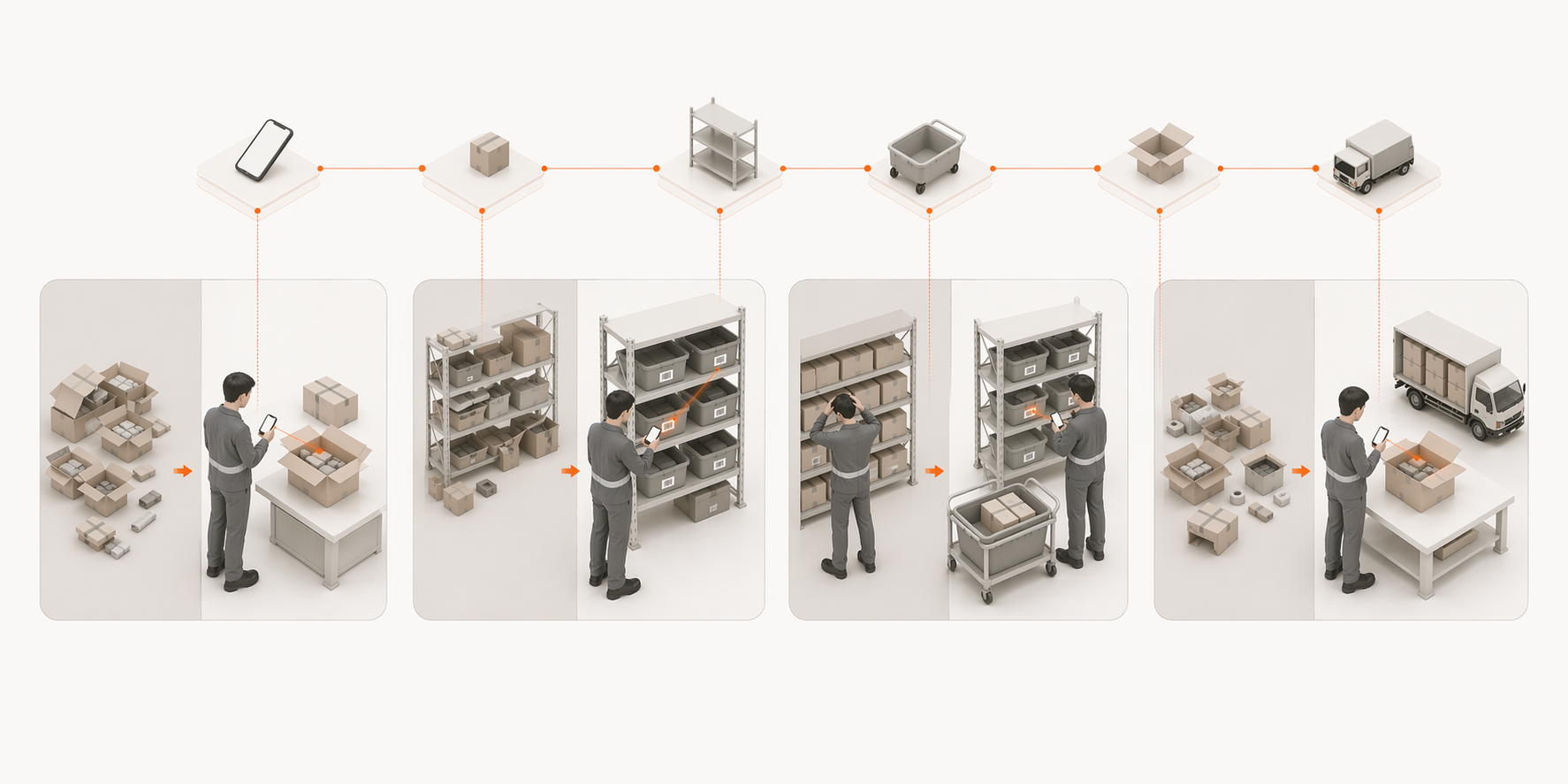
A true warehouse management system provides five core capabilities that Shopify does not.
.
When a supplier delivery arrives, a WMS provides a structured receiving process: scan items in against the purchase order, record discrepancies immediately, assign received stock to specific warehouse locations, and update inventory in real time. Every delivery becomes a verified, timestamped event — not a manual quantity adjustment made after counting.
This matters because a single PO miscount creates a cascade: false stock levels, overselling, emergency reorders, stockouts, refund spikes, and wasted time recounting. Scan-based receiving prevents the cascade at the source.
.
A WMS knows that SKU-103 is in Aisle 2, Shelf B, Bin 14 — not just "Warehouse 1." This enables directed putaway (telling operators exactly where to stow incoming stock), directed picking (routing pickers to the right location without searching), and cycle counting (auditing specific locations rather than the entire warehouse).
Without bin tracking, a warehouse with 500+ SKUs becomes increasingly difficult to operate accurately as it grows.
.
Every physical movement — receive, stow, pick, pack, return — is confirmed by a scan. The scan is the record. This eliminates the gap between physical reality and system state that causes inventory drift. It also creates an immutable audit trail: every movement has a timestamp, an operator ID, and a location.
.
A WMS routes pickers through the warehouse efficiently — grouping items by location, sequencing picks to minimise travel, and batching multiple orders where possible. At 20 orders a day, this is nice to have. At 200 orders a day, it is the difference between a warehouse that runs on time and one that doesn't.
.
A WMS records every stock movement as an event — not just a snapshot of the current count. This means you can replay exactly what happened to any SKU at any point in time. When stock is wrong, you do not have to guess — you can trace every movement back to its source. Shopify stores the current number. A WMS stores the history that produced it.
The Specific Failure Modes of Running a Warehouse on Shopify Alone
These are not theoretical. They are the operational problems that consistently appear as Shopify merchants scale their warehouse operations without a dedicated WMS.
Monday Morning Reconciliation
The weekly ritual of exporting orders, cross-checking pick lists, manually adjusting inventory counts, and trying to explain why Shopify says 23 but the shelf says 19. This typically consumes 2-4 hours of a senior team member's time every week — time that could be spent on growth rather than data repair.
Overselling From Count Lag
Shopify says 5, the shelf has 2. A customer orders 3 and gets a cancellation email. The gap between Shopify's count and physical reality — inventory drift — is the most direct cause of overselling for merchants who manage their own warehouse. See our full guide to stopping overselling on Shopify for the specific fixes.
No Root Cause Tracing
When stock is wrong, Shopify cannot tell you why. It stores the current count — not the sequence of events that produced it. When a discrepancy appears, you ask the team, review paper records, and piece together what probably happened. With a WMS event ledger, you replay exactly what happened. This distinction becomes critical when the same discrepancy keeps recurring — you need to know the root cause, not just reset the count.
Return Re-Entry Chaos
A returned item arrives, gets inspected, is deemed sellable — and sits in a returns area while Shopify still shows it as sold. Over 50 returns a month, that is 50 units of invisible stock. Without a scan-based returns process that updates Shopify at the point of stow, returns consistently inflate your drift. See our inventory drift guide for the full breakdown.
Receiving Discrepancy Blindness
A supplier delivers 94 units against a PO for 100. Without a scan-based receiving workflow, the instinct is to receive everything and chase the shortage later. If Shopify gets updated for 100 rather than 94, 6 phantom units enter the system — and your inventory counts are wrong before the first order ships from that stock.
What to Look for in a Shopify WMS
The market for Shopify-connected warehouse management splits into two categories that leave most SMB merchants in an uncomfortable middle ground.
Enterprise WMS tools — Cin7, Linnworks, ShipHero, NetSuite WMS — are genuinely powerful. They also require multi-week implementations, dedicated IT support, and pricing designed for operations teams managing millions of pounds in revenue. For a Cin7 alternative or Linnworks alternative that fits SMB scale, the feature set needs to match the operational complexity — not exceed it by an order of magnitude.
Lightweight inventory apps — Stocky, basic Shopify apps — handle simple stock adjustments but do not actually manage warehouse operations. They are inventory visibility tools, not WMS tools.
The gap in the middle is where most Shopify merchants live: serious enough to need real warehouse management, but not large enough to justify an enterprise implementation.
When evaluating a WMS for a Shopify warehouse under 500 SKUs, use this checklist:
How a WMS integrates with Shopify
The integration method matters more than most feature lists admit, because it determines whether your inventory is accurate in real time or on a delay.
OAuth connection, not CSV exports
A modern Shopify WMS integration connects through Shopify's OAuth flow — you approve the connection from your Shopify admin, and the WMS receives scoped API access to products, inventory, orders, and locations. Setup takes minutes. The alternatives — CSV exports, scheduled syncs, or middleware connectors — introduce the exact lag that causes drift and overselling.
Webhooks for real-time order flow
When an order is placed, Shopify fires a webhook the WMS receives within seconds. That order enters the warehouse workflow immediately — block check, orders pool, pick queue — without polling delays. The same applies in reverse: when a warehouse scan changes stock, the WMS writes the new level back through the inventory API instantly.
A single inventory writer
The most common integration failure is multiple apps holding inventory write permissions simultaneously. Two systems writing stock levels on different schedules will overwrite each other, and the resulting drift looks random and is painful to trace. The rule: one system owns inventory writes — everything else reads.
What Shopify Plus changes
Shopify Plus raises API rate limits and adds features like multiple expansion stores, but the integration architecture is identical. A WMS built correctly for standard Shopify works on Plus without modification — claims of special "Plus integration" usually describe higher rate-limit headroom, not different capability.
If an integration requires a developer, an implementation consultant, or a multi-week onboarding plan, that is a signal the tool was built for enterprise operations — not for a small warehouse team that needs to be operational today.
Warehouse management needs by industry
The failure modes above hit different verticals differently. Apparel operations break on variant complexity — size and colour matrices multiply every SKU into dozens of trackable units, covered in our apparel guide. Beauty and supplements add expiry dates and batch tracking that Shopify has no concept of — see the beauty and supplements guides. Auto parts merchants need fitment verification before anything ships — detailed in the auto parts guide. And sports and hobby retailers manage seasonal swings across deep catalogues — covered in the sports and hobby guide.
The Right Starting Point
Most merchants hitting the limits of Shopify's native inventory tools are processing somewhere between 50 and 200 orders per day, managing 100 to 500 active SKUs, and running a warehouse team of 2 to 10 people. They are losing 3 to 5 hours per week to manual reconciliation and experiencing inventory discrepancies that erode customer trust.
The answer is not an enterprise WMS implementation that takes 6 weeks and costs more than the problem it solves. It is a warehouse management layer designed specifically for this scale — one that connects to Shopify in seconds, works on mobile without hardware, and turns every physical movement into a real-time Shopify inventory event.
We are building LaSyncro specifically for this gap. If you are currently stuck between Shopify's basic tools and enterprise systems you do not need, start with the Shopify warehouse workflow guide to see how stock should move from receiving to shipping without inventory drift.
LaSyncro adds a full warehouse management layer to Shopify — operational in 60 seconds, not 6 weeks.
Start free